Publications
Parameter-Efficient Reinforcement Learning using Prefix Optimization

Reinforcement Learning with Verifiable Rewards (RLVR)
is a leading approach for tuning language models on mathematical reasoning, but it is unclear whether
its gains stem from genuine reasoning improvements or from steering the model toward answer formats
already present in the reference distribution. We optimize only the first k tokens of each
solution—via a lightweight RL-tuned adapter (Prefix-RL) or a prefix-clustering method—and recover much
of full RL’s accuracy gains at a tiny fraction of the compute, suggesting that part of RL’s benefit is
simply upweighting a preferable solution strategy.
Itamar Rocha Filho, Rosie Zhao, Sham M. Kakade, Eran Malach, Samy Jelassi
ICLR 2026
[OpenReview]
My earlier published research was conducted in the academic environment of the Federal University of Paraíba (UFPB). It is important to point out that three of my internships involved working with research closely to industry research scientists and represent confidential work.
At Meta, I had the pleasure of working with the Behavioural Computing team in London. There, my project consisted of productionizing state-of-the-art speech models. At Google, while working on YouTube, I was responsible for conducting experiments and coming up with new ideas to improve the model used in one of the portions of the video compression pipeline. Industry internships in Machine Learning while still undergraduate are challenging due to competition and complexity. I had this experience in both companies and got great feedback from both teams.
An Approach for Automatic Description of Characters for Blind People
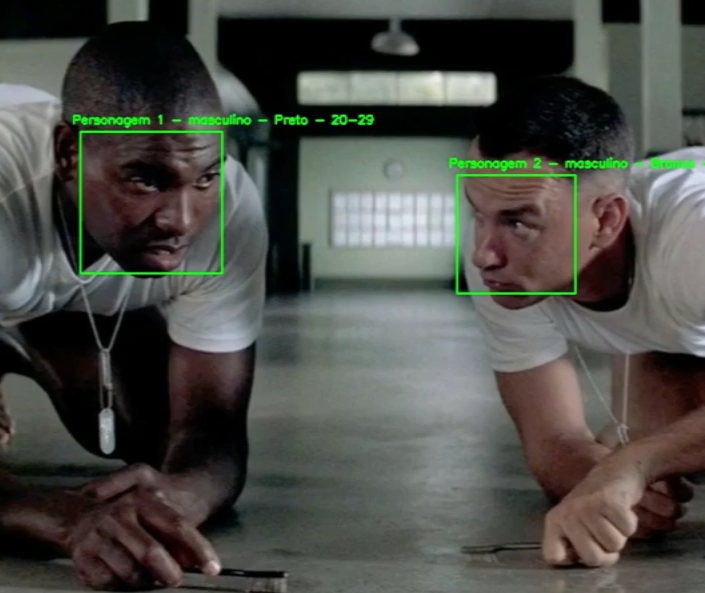 Video Description is a vital accessibility concept in
blind and visually impaired people's life.
Automating this task is not easy and involves many different problems.
This paper presents an approach to automatically describe characters.
Video Description is a vital accessibility concept in
blind and visually impaired people's life.
Automating this task is not easy and involves many different problems.
This paper presents an approach to automatically describe characters.
Itamar Rocha Filho, Felipe Honorato, J. Wallace Lucena, J. Pedro Teixeira, Tiago Maritan
WebMedia 2021
[Paper] [Demonstrations]
Iris-CV: Classifying Iris Flowers Is Not as Easy as You Thought
 The paper shows the results and comparisons of different
computer vision networks and algorithms on our newly created Iris flower image dataset.
The main goal is to propose a new toy/benchmark dataset that is in fact more challenging.
The paper shows the results and comparisons of different
computer vision networks and algorithms on our newly created Iris flower image dataset.
The main goal is to propose a new toy/benchmark dataset that is in fact more challenging.
Itamar Rocha Filho, João Teixeira, João Wallace Lucena Lins, Telmo Silva Filho, Thaís Ramos, Cecília Silva, Ana Clara Chaves Sousa, Felipe de Sousa, Manuel Ferreira Junior, Thaís Gaudencio do Rêgo, Yuri de Almeida Malheiros
BRACIS 2021